Newsletter: Fall 2026
From the Executive Director, Raney Bench
One of the things I love most about working at the MDI Historical Society is seeing how history enriches my life and the lives of those around me. I often find myself turning to history to understand the challenges we face today.
Take MDI High School. Today we take for granted the wisdom of consolidating the island’s three high schools, but history shows it took twenty years of intense debate before the towns agreed. As our communities weigh decisions about the future of island schools, that history offers guidance on how to listen, build consensus, and remember that big decisions take time. Watch this video to learn more.
Our ongoing climate change collaboration, Landscape of Change, is another way we connect with avid-islanders about the island’s past and future. By using historical collections to track change over time, we can better understand the scope, scale, and speed of climate change, an approach that is unique among museums.
I’m honored to share that the Society was one of thirty organizations nationwide selected to join a three-day planning meeting hosted by the Rockefeller Brothers Fund. Together, we worked on developing training and resources to help museums of all sizes and missions engage their communities in climate conversations and planning. The first results, including articles and videos highlighting inspiring museum projects, will be shared this winter. Keep an eye out for them!
As the year comes to a close, please consider renewing your membership and making an annual appeal gift to the Society. Our work is only possible thanks to the generosity of avid-islanders like you. Thank you for helping us continue these fascinating conversations about local history together.
Save the Date!
Stay updating on our upcoming programs here.
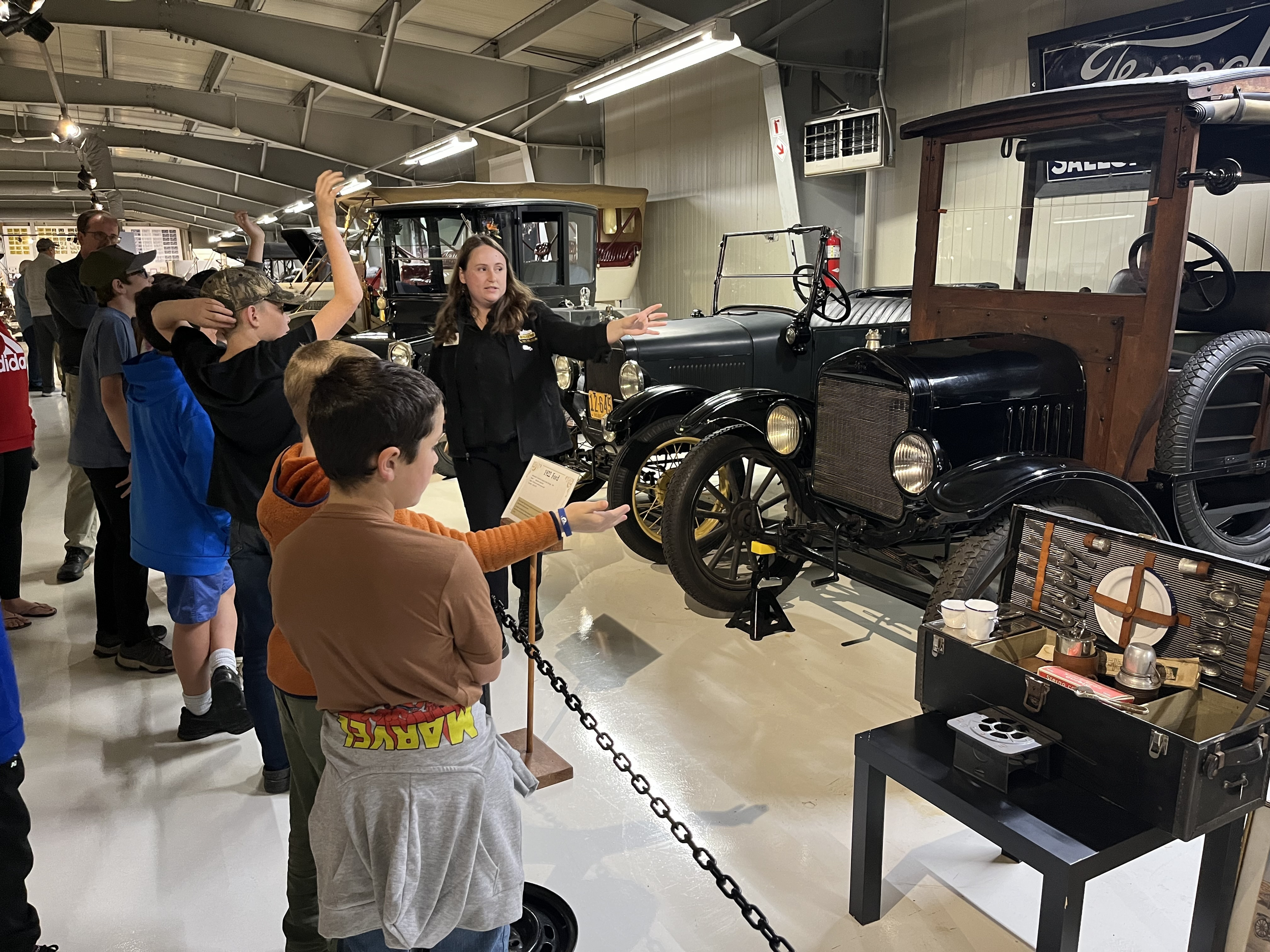
Thursday, October 29 at 5:30 pm - Under the Hood: An Evening at the Seal Cove Auto Museum
@ Seal Cove Auto Museum
Thursday, November 19 at 5:30 pm - Chebacco Author Talk: Battling for the Ballot,
with Catherine McDonald @ Jesup Memorial Library
Tuesday, December 8 at 5:30 pm - History Happy Hour with Jesup Memorial Library
@ Side Street Cafe
Monday, January 18 at 6:00-8:00 pm - 16th Annual Community Baked Bean Supper
@ MDI High School
Summer Programming Review from Lisa Taplin Murray, Assistant Director
The MDI Historical Society’s public programs aim to engage the island’s residents year-round with experiences that are both educational and entertaining. They also let us build and strengthen partnerships with organizations and individuals doing meaningful work across the island, the region, and the nation. Since our May 2026 newsletter, we’ve hosted twenty talks, lectures, and activities across all four towns, drawing an audience of over 1,100 avid-islanders.
Island lore and tall tales. Audiences joined us forlively romps through lesser-known island stories at Raney Bench’s “What Happened Here?” and our collections department’s “Say What? MDI Lore and Tall Tales.”
Learning at the Mill Pond. Throughout May, Acadia National Park and the Somes-Meynell Wildlife Sanctuary educated students at the Somesville Museum about the Mill Pond watershed.
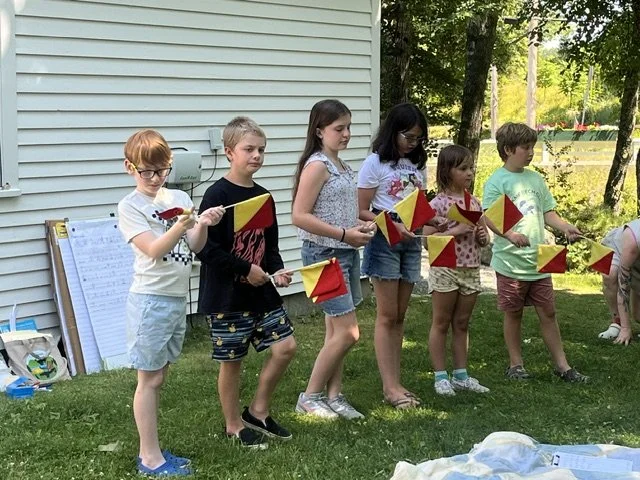
Spy School. Collections Assistant and Somesville Museum docent Jen Heindel taught kids semaphore, Morse code, and ciphers along with the history of communication stations in Acadia National Park.
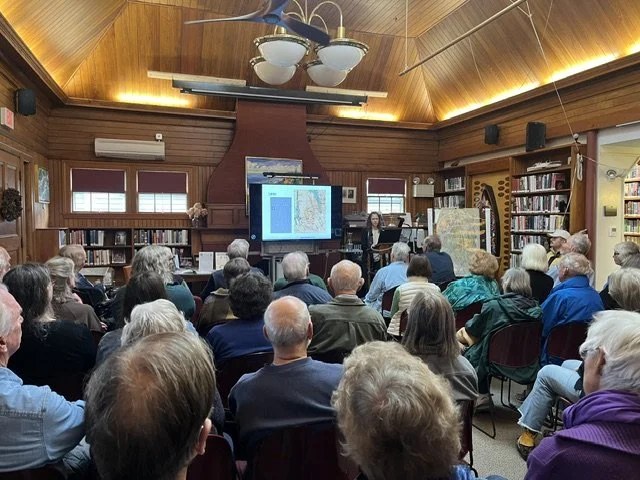
Chebacco authors present. Six Chebacco authors visited island libraries to share the images and research behind their articles, on topics ranging from Otter Creek’s waterfront and Thomas Paine’s legacy to Bar Harbor’s farm-to-table movement and Wabanaki sovereignty.
Community partnerships. We partnered with nearly a dozen organizations on programming. With Hidden Barn Books, we welcomed Brook Wilensky-Lanford to discuss her latest title, A God-Shaped Nation. With Friends of Acadia, we brought author Steve Kemp to the Criterion Theatre to talk about An Exaltation of Parks.
Sharing our climate work. The Mid-Atlantic Association of Museums invited Director Raney Bench to speak at its Pocantico Convening about Landscape of Change, the Society’s climate initiative.
Voyager Circle reception. At our annual Voyager Member gratitude reception, author Catherine Schmitt spoke about the role the island’s trees played in shaping not only Acadia National Park but the nation itself.
Annual meeting. We thanked our members with a potluck dinner at the Neighborhood House, followed by an evening of live music and contra dancing with the Bagaduce Northern New England Ensemble.
Office Damage Update
On the afternoon of August 20, as staff prepared for that evening’s Annual Meeting, our water heater failed dramatically. Water flooded part of the attic and soaked through the first-floor ceiling, damaging the reception area and bathroom below. Fortunately, the damage was contained to that one area; the historic Schoolhouse and our archives were unaffected.
Thanks to our staff’s quick thinking, a team of contractors was on site quickly to limit the damage, and we still pulled off a wonderful Annual Meeting potluck and concert at the Neighborhood House that same night. We’re deeply grateful for the fast, expert response from the Mount Desert Fire Department, Coastal Energy, MCM Electric, Eastern Mold Remediation, Pleasant Air, Dave Trust, and Sean Lucey.
Repairs are nearly complete, and we expect to reopen to the public in late October.
A Peek Into the Box-by Jennifer Heindel, Collections Assistant
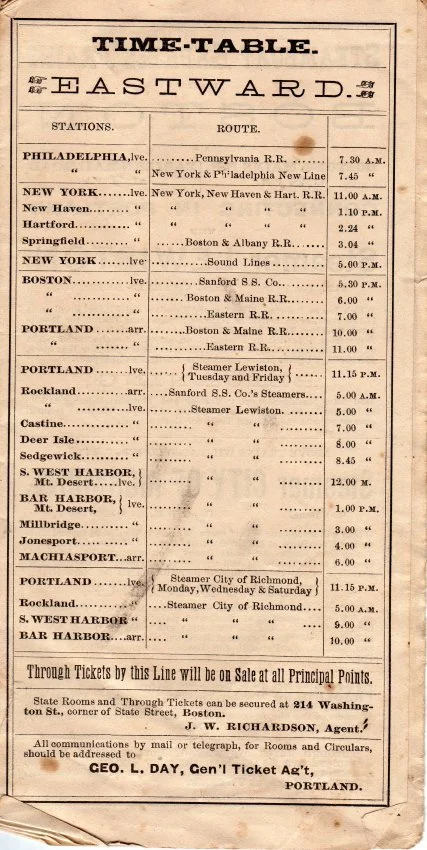
Timetable of trains.
A group of visitors asked me one afternoon at the Somesville Museum how servants travelled to Mount Desert Island. I told them I assumed that during the Gilded Age, they either took the train and then a wagon to the island, or took a steamship, but I had no concrete evidence to prove it.
A quick search of our archives turned up no train or steamship rate tables showing the cost of travel from one place to another. I did learn that in the 1890s there were three classes of train travel: Pullman sleeping cars, second class, and third class. Third class, also called emigrant class, was little more than a seat on a bench. Fares were charged by the mile, generally two to three cents a mile for higher-class tickets.
Then I came across a letter in the Kimball House boxes outlining Mr. and Mrs. Dolan’s travel plans in 1924. They and two maids would arrive on the Bar Harbor Express, with the rest of their staff following later. The Bar Harbor Express was a seasonal train that carried vacationers to resorts along the New England coast and to Bar Harbor.
If the Dolans had a private Pullman car, the two maids would have had a small private area with several berths at one end of the car. If the couple traveled in a suite, the maids likely rode in the open section at the end of the car alongside other maids and porters. Or the maids may simply have had the cheaper upper berths. The rest of the servants probably traveled in the open section or the upper berths as well, but we may never know for sure.
From the Collections - by Patrick Callaway, Collections Manager
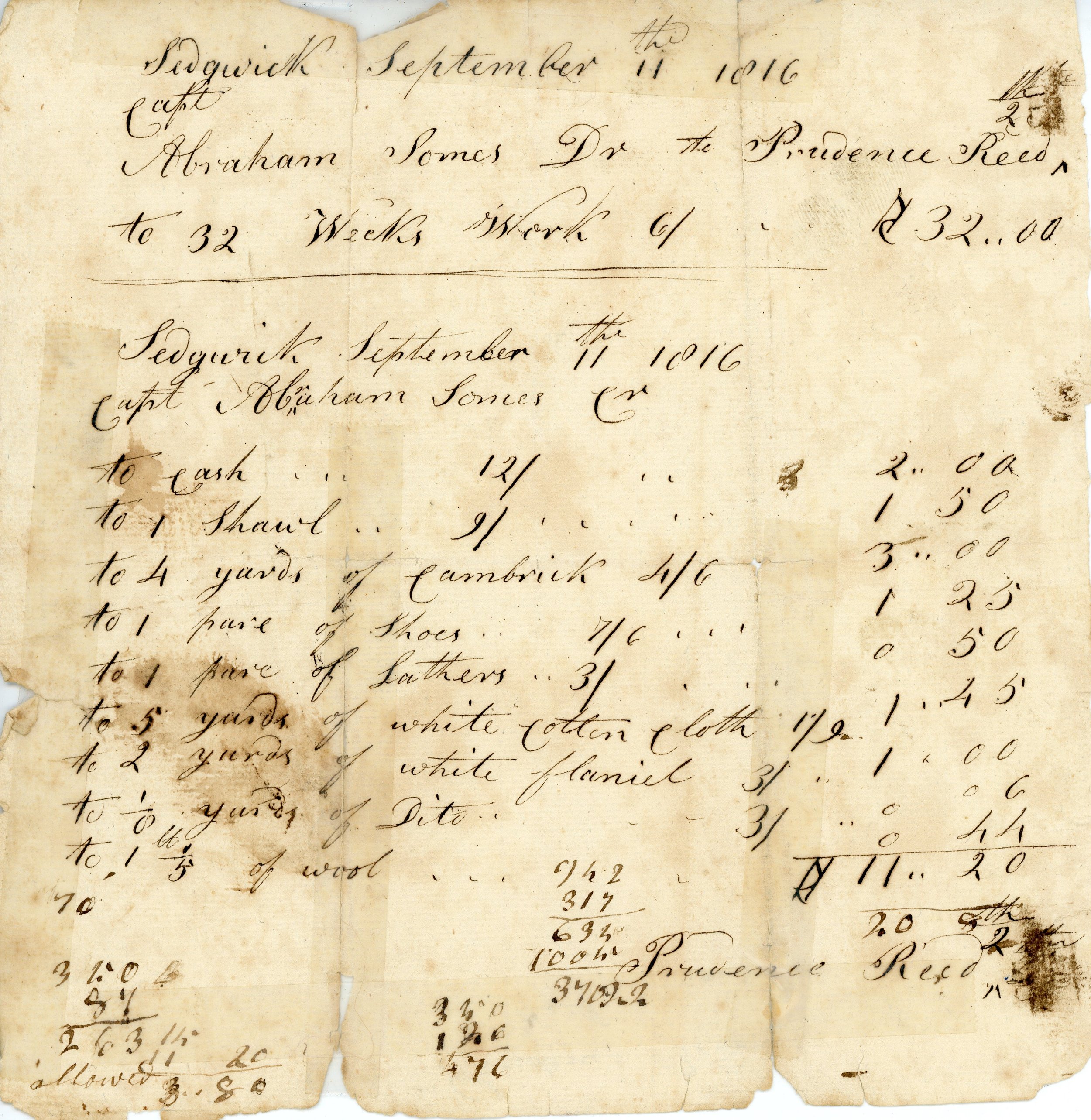
Prudence Reed’s pay slip.
Our ever-expanding collection includes many kinds of items, from physical artifacts like a spinning wheel or a child’s doll, to photographic archives, to documents that recorded everyday life long ago. As a historian, I have a soft spot for written documents. You never know what surprises they hold, and understanding them often means putting your mind in the past to imagine what they meant to the people of the time.
In this edition of “From the Collections,” we focus on one such document: a pay slip dated September 11, 1816, for Prudence Reed from her employer, Abraham Somes. Reed earned the princely sum of $32.00 for 32 weeks of work, or $1 per week. That’s roughly $23.76 a week in today’s dollars, though comparing prices across 210 years is never exact. We don’t know whether housing, food, or other necessities were provided to supplement her wage.
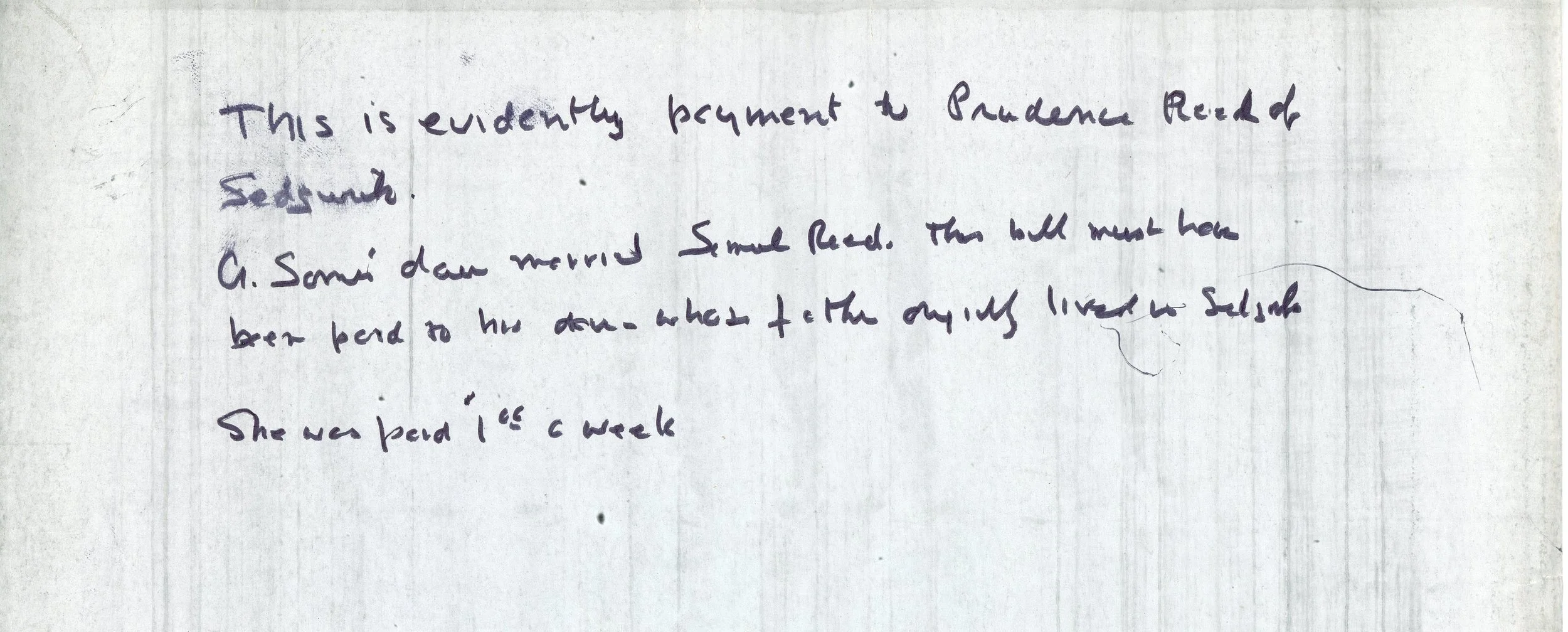
The attached note from our archives.
The slip also shows several deductions from her pay for fabric, along with one cash payment. Curiously, there are no deductions for anything else, which raises the question of why fabric was deducted from her pay but nothing more. A cryptic note attached to the document in our archives reads: “This is evidently payment to Prudence Reed of Sedgewick. A. Somes’ dau (daughter?) married Samuel Reed. This bill must have been paid to his dau (daughter?) who (???) lived in Sedgewick.”
The pay slip also shows the challenges of caring for two-hundred-year-old documents. It has noticeable tears and fraying, and not every past effort to preserve it was helpful. At some point, someone repaired it with Scotch tape. Over time, tape adhesive breaks down chemically, which can stain and physically damage the paper. Fortunately, we have access to the technology and skill needed to remedy this sticky mess.
2027 Chebacco News
People are often amazed to learn that Chebacco themes are planned at least two years in advance. With that in mind, we’re now seeking authors for the 2028 edition, “Sinners and Saints.” We do history a disservice when we say “times were simpler.” Times were never simpler; each generation faced the most complex challenges of its day. Flattening history into heroes and villains distorts our understanding of real people and their place in the human story. People are complex, and history is never just one thing or the other. Even how we judge the past shifts over time, shaped by the values we hold today.
Most people are a little of both, sinners and saints. To know their full stories is to see ourselves reflected in their struggles, contradictions, and moments of grace. This edition will explore the complexity of human experience on MDI, challenging what we think we know and reimagining the people who shaped this island. To submit an article idea, visit our website for details. Make sure your membership is current so you don’t miss Chebacco 2027, Notes from the Island, our music edition! Authors are finishing their articles now, with stories about town bands, music festivals, noted musicians, cultural traditions, and the spaces that bring music to all island communities.
Welcome Katie Lipman!
We’re delighted to announce that Katie Lipman has joined the MDI Historical Society as our new Office and Visitor Services Manager. As our work connecting people to history across all island communities grows, so does our team.
Katie brings a passion for history and customer service to the role. She’ll welcome visitors to the Sound Schoolhouse for tours and provide vital office support and coordination for our board and staff.
Creative and skilled in communication and marketing, Katie loves helping people connect with history, something she’s done at Acadia National Park and as a graduate student at UMass Boston. Her editorial experience with the New England Quarterly will serve her well as she oversees production details for Chebacco and works with its authors and editors. Her marketing experience with the Connecticut Historical Society will help us reach more people with stories, profiles of islanders, and announcements.
“I am very excited to be working with the MDI Historical Society! Having worked at a museum and a historical journal in the past, I am very happy to be returning to a field of work based in preservation and education. I am looking forward to the opportunity to support this work and engage with the community on MDI.” – Katie Lipman
Your Grocery Bag Can Help Preserve Island History

The MDI Historical Society has been selected as a nonprofit partner in the Hannaford Community Bag Program.
Throughout November 2026, we’ll receive $1 for every reusable Community Bag sold at the Bar Harbor Hannaford. Every bag you buy supports our work preserving and sharing island history, and it helps keep plastic out of MDI’s woods and waters.
A big thank-you to Hannaford, which has also sponsored our Community Baked Bean Supper for more than fifteen years. We’re grateful for their long-standing support!
Membership Renewal Reminder
Many of you will soon receive a renewal reminder for continued membership in 2027. We couldn’t accomplish what we do without our members.
Thank you for your ongoing support!
Follow Us
Follow us on Facebook and Instagram, and subscribe to our YouTube channel. We share all kinds of content!